




BENEFITS
A substantial number of new power plants in the world would not need to be built if TIC is used to utilize the hidden capacity of existing combustion turbine plants. TIC provides economic and environmental benefits. These benefits are good for the combustion turbine plant owners, the ratepayers and the general public. A brief qualitative list of TIC benefits is available.The overall economic benefit of TIC is that it helps optimize CT assets in new or existing simple-cycle, cogeneration and combined-cycle systems. When ambient temperature is above 59oF, some specific benefits of TIC include the following:
- Increased power output
- Reduced capital cost ($/kW) per unit of power plant output capacity
- Increased fuel efficiency
- Increased steam output in cogeneration systems
- Increased power output of steam turbines in combined-cycle systems
- Improved predictability of power output by eliminating the weather variable.
Increased Power Output
The primary benefit of TIC is that it allows the plant owners to reduce or prevent loss of CT power output, compared to the rated capacity, when ambient temperature rises above 59oF or if the plant is located in a warm/hot climate region. TIC can even allow the plant owners to increase the CT output above the rated capacity by cooling the inlet air to below 59oF as shown in Figure 1.
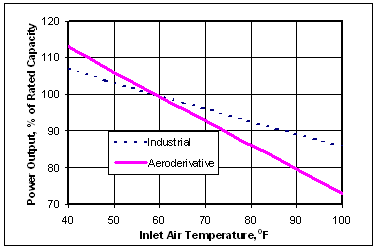
Figure 1. Effect of Ambient Temperature on the Output of CTs
Reduced Capital Cost Per Unit of Power Plant Output Capacity
If a power producer does not apply TIC but wants or needs to make up for the lost capacity due to an increase in ambient temperature, its only option is to incur the capital cost of installing another CT (or another type of generator) and bringing it online to make up for the lost capacity. As discussed later in this section, the option of installing another CT (as a peaking turbine) is usually more expensive than using TIC for the baseline CT system.
Increased Fuel Efficiency
A significant secondary benefit of TIC is that it also reduces or prevents a decrease in fuel efficiency (increase in heat rate) of the CT, compared to the design efficiency/heat rate, due to increase in ambient temperature above 59oF. Figure 2 shows the effect of inlet air temperature on heat rate (fuel required per unit of electric energy) for the two types of CTs discussed in the earlier section.
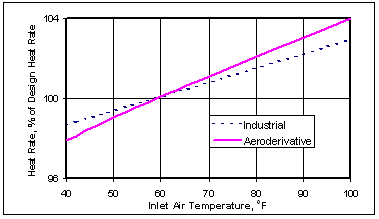
Figure 2. Effect of Ambient Temperature on CT Heat Rate
It shows that for an aeroderivative CT an increase in inlet air
temperature from 59oF to 100oF increases heat rate (and thus, decreases fuel efficiency) by 4% (from 100% at 59oF to 104% at 100oF). TIC could even help increase fuel efficiency (decrease heat rate), compared to the design efficiency/heat rate, by cooling the inlet air to below 59oF. For example, for a typical aeroderivative CT in Figure 2, cooling the inlet air from 59oF to 42oF reduces the heat rate (increases fuel efficiency) by about 2% (from 100%to about 98%).
Increased Steam Output in Cogeneration and Power Output of Steam Turbine Output in Combined-Cycle Systems
TIC not only reduces or prevents loss of CT power output; it also reduces or prevents loss of steam produced in cogeneration systems and loss of power output of steam turbines in combined-cycle systems when ambient air temperature increases above 59oF. As discussed earlier, the power output of a CT decreases with an increase in ambient temperature because the mass flow rate of inlet air decreases. This decreased mass flow rate also results in decreased total energy in the CT exhaust gases which in turn leads to reduced steam production in the heat recovery steam generators (HRSG). The reduced steam generation in the HRSG results in lower output of steam turbines in combined-cycle systems.
Improved predictability of power output by eliminating the weather variable
Some of the TIC technologies (discussed later) allow CT operations at any desired temperature, as low as 42oF, independent of the weather conditions. Therefore, these technologies facilitate predictable power output at all times and eliminate weather as a variable in predicting power output of power plants using CTs.